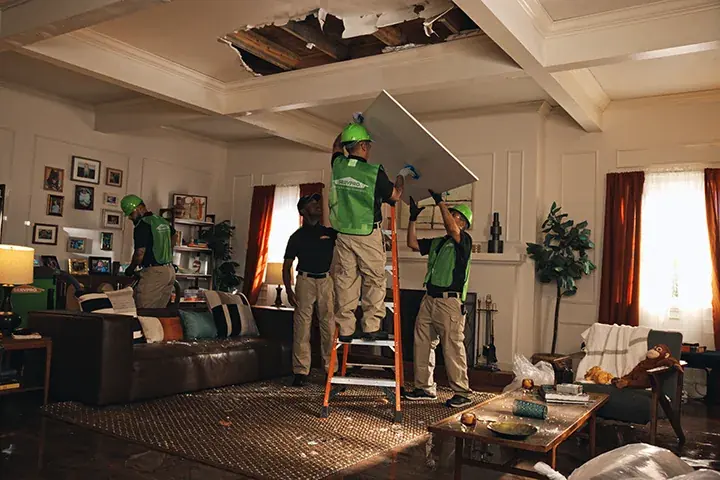
How the crew handles ceiling leak water damage in Pasadena
Call and dispatch
A real person answers 24/7 and the nearest Pasadena crew rolls with pumps, air movers, and moisture meters.
On-site assessment
The crew traces the source and the full reach of the water, including what soaked into subfloor, plaster, and wall cavities.
Extract and dry
The extraction crew pulls the standing water, then runs air movers and dehumidifiers to the IICRC S500 standard, not just the surface.
Verify and document
The drying team logs moisture readings until the structure reads truly dry, then documents the loss for your insurance claim.
A ceiling that is stained, bubbling, or starting to sag means water has worked into the cavity above your rooms and is pooling there. Whatever sent it up there, the ceiling is the damage the crew fixes. The response team answers live around the clock and covers Madison Heights, Bungalow Heaven, Chapman Woods, Washington Square, and the rest of Pasadena day or night. Call (626) 314-6471.
What a stained or sagging ceiling is telling you
Water above a ceiling shows itself long before it comes through, and the early signs are easy to write off until the plaster is soaked. Watch for these:
- A brown ring or a spreading stain that grows a little each day
- Paint or plaster that bubbles, blisters, or flakes overhead
- A ceiling that bows, dimples, or feels soft where it was flat
- Drips or beads at a light fixture or the ceiling's lowest seam
- A damp, musty smell in the room below or the hallway
None of these are only cosmetic. A ceiling holding water can let go all at once once the plaster is fully saturated, and the longer it stays wet the further the moisture spreads through the framing and down into the walls.
Where the water above your ceiling is coming from
A wet ceiling is a symptom, not the source, and the source is almost never directly above the stain. Water tracks along the top of the ceiling, down rafters, and inside wall cavities before it finds a low seam or a fixture to come through. The usual origins in Pasadena homes are a roof leak overhead, an overflowing upstairs tub or toilet, a supply or drain line in the ceiling, and a clogged HVAC condensate line in the attic. If the trail leads up to the roof, the roof leak water damage crew tarps and stops the intrusion up top while crews dry the ceiling below, and the Ready.gov guide to floods is a useful primer on moving fast once water gets loose inside a home.
Saving Craftsman plaster instead of gutting the ceiling
Many Pasadena homes still have their original plaster-and-lath ceilings, and a crew in a hurry is quick to cut them out. Crews do the opposite. Crews make small, controlled openings only where they are needed to drain and dry the cavity, then the structural drying crew dries the plaster in place wherever it can be saved. Crews take out only the material too far gone to dry safely, which keeps a hundred-year-old ceiling in a Bungalow Heaven or Madison Heights home where it belongs instead of in a dumpster.
Stopping mold above the ceiling
Trapped moisture above a ceiling is exactly where mold takes hold, out of sight in the attic or the cavity. Once the space reads dry crews confirm it with meters, the water extraction and removal crew clears any water that reached the floor below, and when needed the mold remediation team treats the cavity before anything is closed up. The EPA guide to mold explains why a hidden, damp cavity is such a common place for it to start.
Seeing a stain spread or the ceiling start to sag? Call now and a crew heads out across Pasadena to find the source and dry the cavity before the plaster gives way.
☎ Call (626) 314-6471Original ceilings worth saving
The Craftsman bungalows of Bungalow Heaven and the older homes around Madison Heights and Chapman Woods carry original plaster-and-lath ceilings that a modern crew is quick to tear down. Crews dry them in place wherever crews can, so a hundred-year-old ceiling stays where it belongs instead of ending up in a dumpster after a leak that could have been dried.
Why Pasadena homeowners call us
Rapid local response
The response team answers 24/7, and the nearest crew heads out the moment you call, across Pasadena and the San Gabriel Valley.
IICRC S500 drying standard
Crews take daily moisture readings and dry to the IICRC S500 standard before the equipment comes out, not just the surface.
Claim-ready documentation
The loss is documented with photos and daily moisture readings, the paperwork an adjuster needs to move a claim.
Local water damage experts
From galvanized pipes to slab foundations and foothill runoff, the local pros know how water moves in Pasadena and the San Gabriel Valley.
From Old Pasadena across the west San Gabriel Valley
Pasadena water damage pros respond city-wide and across the west San Gabriel Valley, day or night.
Local crews cover all of Pasadena and the west San Gabriel Valley, day or night. Whoever answers the Pasadena line asks for the cross street and which level of the home is wet.
Coverage runs across Pasadena, Altadena, South Pasadena, San Marino, Arcadia, Sierra Madre, La Canada Flintridge, Monrovia, San Gabriel, Temple City, and Alhambra.
See every neighborhood and ZIP covered ›Related restoration services
Common questions, answered
My ceiling is stained but not dripping, should I still call?
Yes. A stain means water has already gathered in the cavity above and is sitting on the plaster. It may not drip until the plaster is saturated, so it is safer to have us check behind the surface before hidden moisture turns into a sagging ceiling and mold.
Can a ceiling leak show up far from where the water got in?
Yes. Water tracks along the top of the ceiling, down rafters, and inside wall cavities before it comes through, so the stain you see is often a room or two from the real source. Crews trace the actual path instead of opening the ceiling right under the stain.
What makes water pool above a ceiling?
The ceiling is the damage, but the water can start anywhere above it: a roof leak overhead, an overflowing upstairs tub or toilet, a supply or drain line in the ceiling, or a clogged HVAC condensate line in the attic. Crews find which one it is before crews dry.
Can you save my old plaster ceiling?
Often, yes. Crews dry original plaster and lath in place wherever crews can rather than tearing it out, which matters in older Pasadena homes in areas like Bungalow Heaven and Madison Heights. Crews only remove what is too far gone to dry safely.
Is a sagging ceiling dangerous?
It can be. A ceiling holding water can let go all at once once the plaster is fully saturated. Keep people and pets out from under a bulging spot and call us, and a crew will relieve the water safely and dry the cavity above it.
How do you dry a ceiling without tearing it all out?
Crews make small, controlled openings only where they are needed to drain and reach the cavity, then set air movers and dehumidifiers and dry it to a verified standard. Careful drying saves the finished ceiling wherever the plaster can still be brought back.
Can mold grow above the ceiling after a leak?
Yes. Trapped moisture in the attic or the ceiling cavity is a common place for mold to start, out of sight. Crews dry the whole cavity, not just the visible ceiling, confirm it with meters, and treat at-risk areas so mold does not take hold.
How fast can you get to my home?
Crews reach most of Pasadena and the west San Gabriel Valley day or night, day or night. The sooner crews find the source and start drying, the less the water spreads through the ceiling and down into the walls.
Pasadena's water damage crew is standing by
Water sitting means damage growing. Call SOS Restoration and a Pasadena crew heads out across the San Gabriel Valley, day or night.
(626) 314-6471One call brings a Pasadena crew to your door, any hour